Retirement Red Zone: Why Years Around Retirement Matter More Than Almost Any Other Period of an Investor’s Life


For most investors, the five years before and after retirement represent the most consequential period of their financial lives. Although an investor can spend forty years saving and investing, these ten years, often referred to by practitioners as the “retirement red zone”, can have a disproportionate impact on whether that lifetime of accumulated savings ultimately supports the retirement they envisioned. The reason: the intent of the portfolio changes.
During the accumulation years, an investor is primarily saving money. Market declines can be uncomfortable, but time is an ally. At retirement, the equation changes. Typically, the investor stops adding meaningful savings and begins withdrawing from the portfolio. Without proper planning, a significant market decline early in retirement can therefore do far more damage than the same size decline during the accumulation years, or even a market decline of similar size that comes further into the retirement years. Withdrawals during a decline permanently reduce the capital available to participate in the recovery. This is the essence of sequence-of-returns risk and the risk is greatest in the “retirement red zone”— when three things converge: the portfolio size and cumulative contributions are often near their peak, and the investor is transitioning from contributing savings to withdrawing those savings.
As retirement becomes a reality, thoughtful portfolio positioning, disciplined risk management, adequate liquidity, and ongoing communication with advisors all contribute to the likelihood of success of a retirement plan. During the “retirement red zone”, the portfolio has less time and less flexibility to recover from unnecessary risk, severe mistakes, or an unfortunate sequence of events. Therefore, the goal of retirement planning is not simply to maximize the average expected return of your savings, but to build a portfolio whose path is durable enough to allow compounding to continue working for the investor, not against you.
Compounding: The Eighth Wonder of the World
Compounding is often described as the most powerful force in investing — but that power is agnostic to direction. The same geometric growth that rewards patience in accumulation can just as easily punish poor timing in your withdrawal years, especially when a portfolio is ill-equipped to withstand a sustained period of unfavorable returns.
Accumulation Phase – The Helpful Side of Compounding
Most of us know that compounding can work in favor of an investor. For example, imagine two investors who each invest $10,000 per year and earn an average 8% annual return:
- Investor A starts at age 25 and invests for 40 years → $2.59 million
- Investor B waits until age 45 and invests for 20 years → $458,000
Investor A contributed $400,000 over their career, while Investor B contributed $200,000. The real difference, however isn’t as much about the additional $200,000 of contributions, it is mostly attributable to the extra two decades of compounding. During the accumulation phase, time is an investor’s greatest asset. Early dollars have decades to earn returns, and then those returns earn returns of their own. By retirement, compounding—not contributions—can become the dominant source of portfolio growth. It is also why protecting the capital base becomes increasingly important as retirement approaches.
During the accumulation phase, a bad year early in your career, instead of having that bad year late in your career, can come with some benefits — you buy more shares at lower prices, and time repairs the damage. However, the moment you flip from saving to spending, compounding can work against you. The withdrawal phase is the period in which risk needs to be managed with the greatest intentionality. This side of compounding receives far less attention.
Withdrawal Phase – Compounding Combined with Sequence Return Risk
To illustrate sequence-of-returns risk and how compounding can work against you, consider two retirees, each starting with $1,000,000 and withdrawing $50,000 at the start of each year for ten years. Both experience the exact same ten annual returns — Retiree A gets them in one order, Retiree B gets the mirror image but in reverse order. The arithmetic average return for both is identical: 7.5% per year.
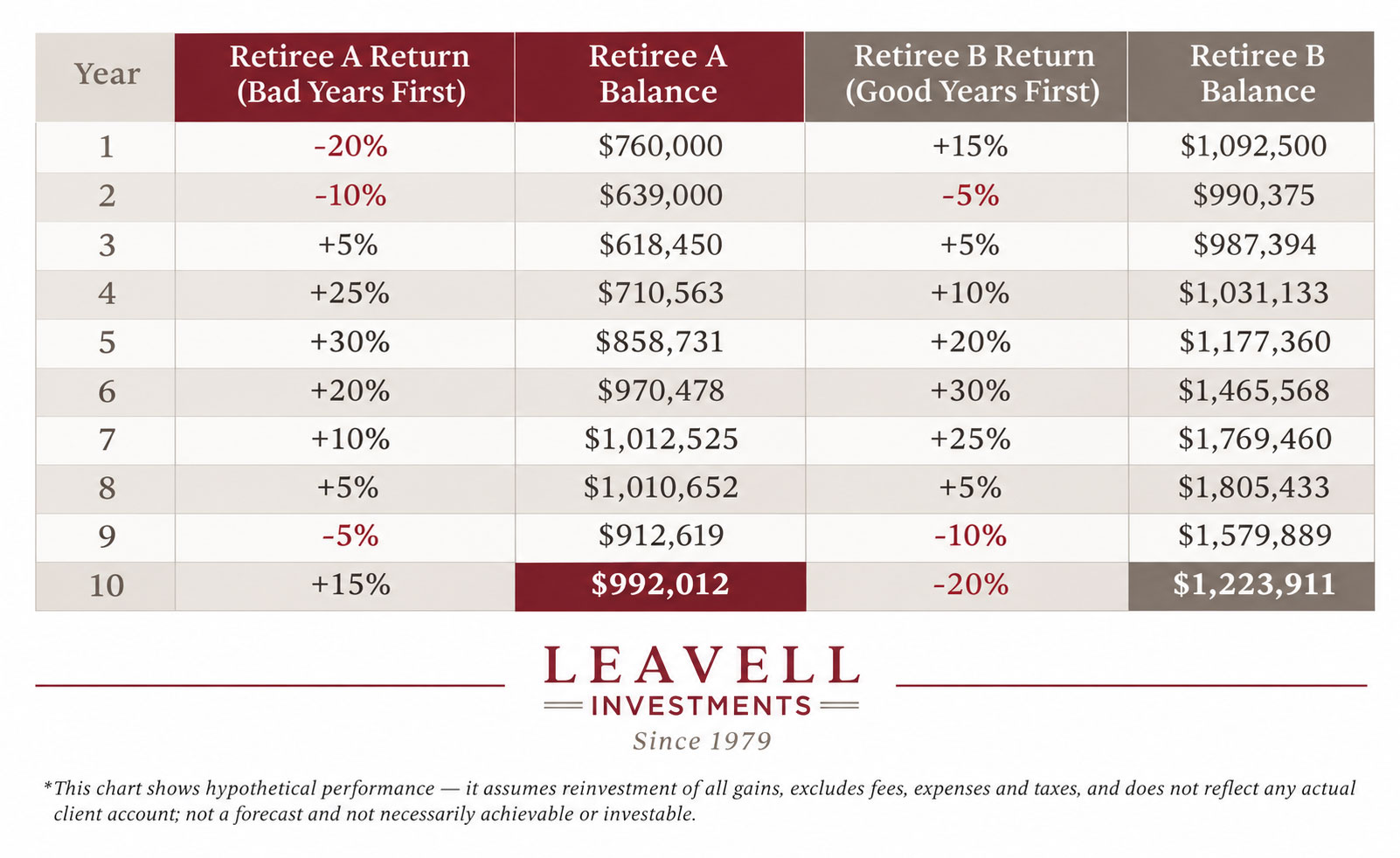
Same ten returns. Same average annual return. Same withdrawals. Retiree B ends up with $1,223,911 — nearly $232,000 more, or 23% more, than Retiree A’s $992,012. The only difference was the order in which the returns arrived. Run the same two sequences with no withdrawals and no contributions — and both retirees end at the identical $1,860,201.
The problem in the scenario above is not simply that Retiree A experienced a 20% decline. The problem is that savings were removed from a shrinking foundation early in the sequence. When markets eventually start to recover, the investor is no longer recovering with the original $1 million. They are recovering with a materially smaller pool of savings. The distinction is important: during a contribution phase, market declines can create an opportunity to buy more assets cheaply with new money, but forced withdrawals during retirement compound the pain in the midst of a market decline.
Protecting the Portfolio When Timing Matters Most
The good news is that these market declines, or poor sequences of returns, do not have to carry the same consequences for every investor approaching or in retirement. The greatest risk of a poor sequence-of-returns early in retirement is when it is combined with a portfolio that is too dependent on stocks for near-term spending, too concentrated or illiquid, or too inflexible to withstand the timing of the drawdown. Giving disproportionate attention to portfolio construction and retirement planning during this integral phase can be the difference maker in the success of a plan.
Prudent and intentional portfolio construction — including a reserve of stable, liquid assets to draw from during downturns — can prevent market declines from forcing retirees into selling depreciated assets to fund living expenses. Having a reserve buys the portfolio time and funds everyday living. Meanwhile, stocks are given time to recover, and the sequence-of-returns that so often determines retirement outcomes is worked with, rather than against.
In addition to portfolio positioning, retirement planning tools such as a Monte Carlo Simulation can provide further stress testing by examining the distribution of possible outcomes, testing thousands of potential market and withdrawal sequences rather than relying on a single assumed rate of return. As an education and planning tool, it illustrates how sequence of returns, volatility, inflation, withdrawals, and portfolio allocation can affect the probability of sustaining a retirement plan. Most importantly, it helps identify vulnerabilities and it gives clients a clearer understanding of the trade-offs between spending today, taking investment risks, and preserving financial flexibility for the future. This is where investment management and financial planning need to work together.
At Leavell Investments, every client has both a dedicated portfolio manager and an investment counselor. This structure is unique in our industry and allows two distinct areas of expertise to work together: the portfolio manager focuses on investment strategy and portfolio construction, while the investor counselor focuses on the client’s broader financial plan, retirement objectives, cash-flow needs, and long-term goals. By bringing these disciplines together, we can evaluate not only what a portfolio is expected to earn, but how the path it might take is positioned to support the client’s life and spending needs through different market environments.

C. Dalton Nix, CIMA® joined the Leavell team in 2016. He previously worked for an Atlanta-based boutique investment bank and operational advisory firm that helped privately held businesses navigate merger and acquisition transactions. Dalton holds the Certified Investment Management Analyst® certification, administered by Investments & Wealth Institute® and taught in conjunction with the Yale School of Management. He graduated cum laude with a degree in finance and a minor in economics in 2007, and later earned his MBA in 2011, both from The University of Alabama. Dalton is an avid outdoorsman and enjoys spending time with his family.
Leavell’s Team-Based Approach to Client Relationships
At Leavell, we believe exceptional financial guidance begins with a collaborative approach. Every client is supported by a dedicated team that ensures personalized, comprehensive, and responsive service.
Each client team includes:
- Investment Counselor – Your primary advisor, focused on understanding your financial goals, risk tolerance, and long-term objectives. The Investment Counselor designs a customized investment strategy and holistic financial plan tailored to your unique needs.
- Portfolio Manager – Responsible for executing your investment strategy. The Portfolio Manager makes investment decisions, actively monitors market conditions, and adjusts portfolios to stay aligned with your goals.
- Client Service Representative – Delivers attentive, high-touch service. From account setup and document management to money movement and ongoing inquiries, your Client Service Representative ensures every detail is handled with care.
This team-based structure enables Leavell to provide well-rounded support and long-lasting client relationships built on trust, expertise, and continuity.
Important Disclosures: The statements and opinions expressed in this article are those of the authors as of the date of the article, are subject to rapid change as economic and market conditions dictate, and do not necessarily represent the views of Leavell Investment Management, Inc. This article does not constitute investment advice, is not predictive of future performance, and should not be construed as an offer to sell or a solicitation to buy any security or make an offer where otherwise unlawful. Investing in securities carries risk including the possible loss of principal. Individual circumstances vary. Past performance is no guarantee of future results.